We Have a Chance to Beat AI
The takeover of artificial intelligence feels like a wildfire closing in on us from all sides. The average person never asked for this, but in a way it's been our fault. Our preferences have laid the deadwood and technology lit the match. And that is exactly where the power is: if we are the demand, we are also the only thing that can change it. We still have a chance to cut a firebreak before it's too late. I see a path where humans win.

A firebreak is an intentionally cut line through a forrest or crops that stops the spread of a fire. It sacrifices some of the trees or crop yield per acre to prevent catastrophic destruction.
When I started making content my Dad gave me the advice to "make it appealing to the broadest audience — like sports." I can unironically describe him as an uber-successful corporate leader and strategist. From his perspective in the C-suite, this is the correct approach. Business is a game of scale and efficiency. A product for the largest audience at the lowest cost, with a healthy markup, generates maximum profit. But is that the goal of the average person?
Large businesses supply what the market demands. For the past fifty years the Western market has demanded, perhaps unconsciously, "give us more stuff, cheaper, delivered faster and easier to use than it was yesterday." For decades corporations aligned accordingly. Products were stripped of detail, function and quality. Labor was outsourced to more "cost effective" markets. This is why we have the $14.99 white plastic folding chairs at Walmart, arriving on containerships by the millions, just functional and inoffensive enough to replace the hand-carved works of craftsmanship our grandparents casually sat on.
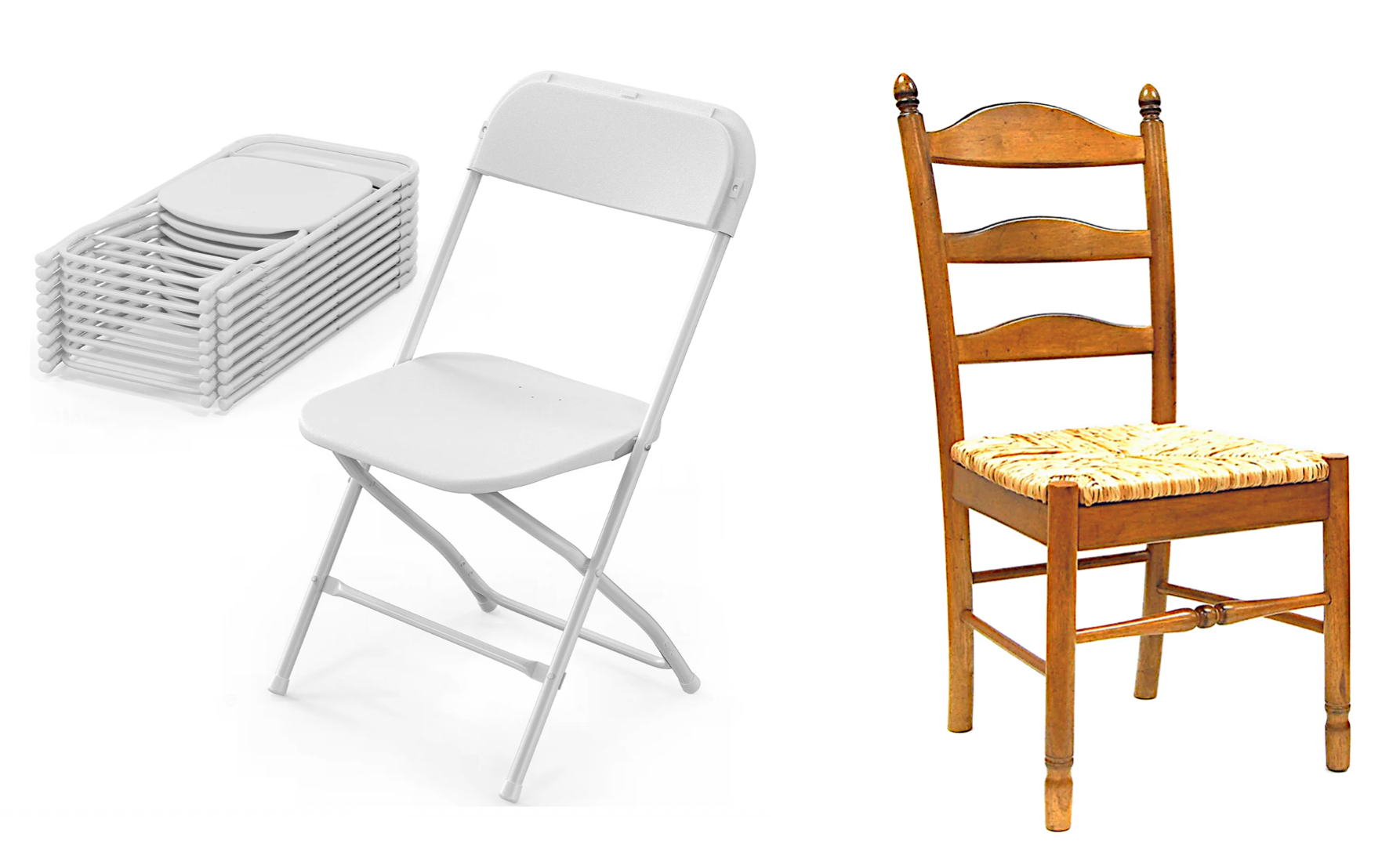
You can buy this 10 pack of chairs at Walmart for $129.99
Artificial intelligence is the ultimate tool for maximizing volume, speed and cost cutting. But unlike that soulless chair, software, digital products and AI generated content have no marginal cost. A physical product has to be made, shipped, and stocked. A piece of content can be generated once and distributed to the largest audience that will accept it at effectively zero cost. There is no factory, no containership and no ceiling. The concern now is that AI isn't making chairs – it's generating creative work. We asked for more, cheaper, faster, easier, and we got it. Be careful what you wish for.
Unlike physical goods, the joy of creative work isn't the product – it's the process. A real writer wants to think and wordsmith their way through their opus; an artist works the layers of their medium until reality meets their vision. The process feels like connecting to something larger than yourself and channeling it through your own hands.
This is where the two halves of the problem meet. This tool has landed in a system that was already built to reward output over craft. If you've never toiled to bring an idea into reality, cheap output gives you the rush of results without feeling the loss of anything, because you never knew the feeling of creation. For some people, and certainly for most corporations, pride and fulfillment were never the objective. For them, the output is measured in quantity, not quality, and the market has spent fifty years teaching everyone that speed and quantity is what pays.
The real tragedy is the creative who has felt the rush of the process and discards it anyway for the frictionless output of a machine. To know you've lost something is a far greater pain than never having it. And we incentivise this. Why toil over your craft when the market will accept and reward a deluge of slop over a trickle of hard earned human excellence?
I am not saying we should stop using AI. I'm a huge proponent of it. It's a tool — and like a hammer can be used to "build a house, or hit yourself in the dick," in the eloquent words of Joe Rogan, AI can be used to build or to destroy.
I use it to scour the web of human knowledge and weigh both sides of a problem. It’s generated code I could never write myself to build tools for my website. What I don't do is hand it my writing. The best use I've found is as a technical partner that fills the holes in my skillset and picks up the tedious tasks that steal time from the creative work. It should clear space for your creativity and amplify it — not replace it. I'd take as much pride in posting an AI generated essay as I would in walking to my bookshelf, scratching out an author's name, and writing my own on the cover.
The real solution is a re-evaluation of what we want. So long as we demand more, faster, cheaper, easier, the market will supply it — and that is a race humans can no longer win. But we don't have to run it. If we're willing to slow down and accept that quality has worth separate from quantity, we give ourselves a chance. The West is a world of abundance. The poorest 5% of Americans earn at the 68th percentile of the global income distribution. Our instinct for "more, cheaper" is solving a scarcity problem we no longer have. Our problem isn't a lack of cheap stuff — it's the excess of it.
The time to cut the firebreak is now. Consume a smaller amount of higher quality and you change the incentives. That goes for food. That goes for products. That goes for content. We are the demand. There is power in that.