What is a Good Decision?
How do you know if you’ve made a good decision?
I consider a choice to be well made if:
The decision is aligned with your values and increases the likelihood that you achieve your goals.
That simple sentence smuggles in the deep concepts of values, goals and the probabilistic nature of life. Let’s unpack those.
Your values are ideals that you hold for yourself. You may have never listed them explicitly but you know them through your emotions. They manifest in your envy and your anger. You envy people that represent your values that you haven't lived up to yourself. You tend to feel anger and distaste towards people that act outside accordance with your values.
The psychologist Shalom Schwartz defines values as beliefs about desirable end states or behaviors that transcend specific situations and guide how people evaluate actions. They are ordered by relative importance to the person. Human values are all ideals, but ones across the circle from each other are in tension. I tend to value self-direction, stimulation and benevolence most. I hold achievement as an ideal as a proxy for personal competence. Because of this, I don’t value security, power, pleasure or tradition much at all. I am in strong tension with universalism and conformity.
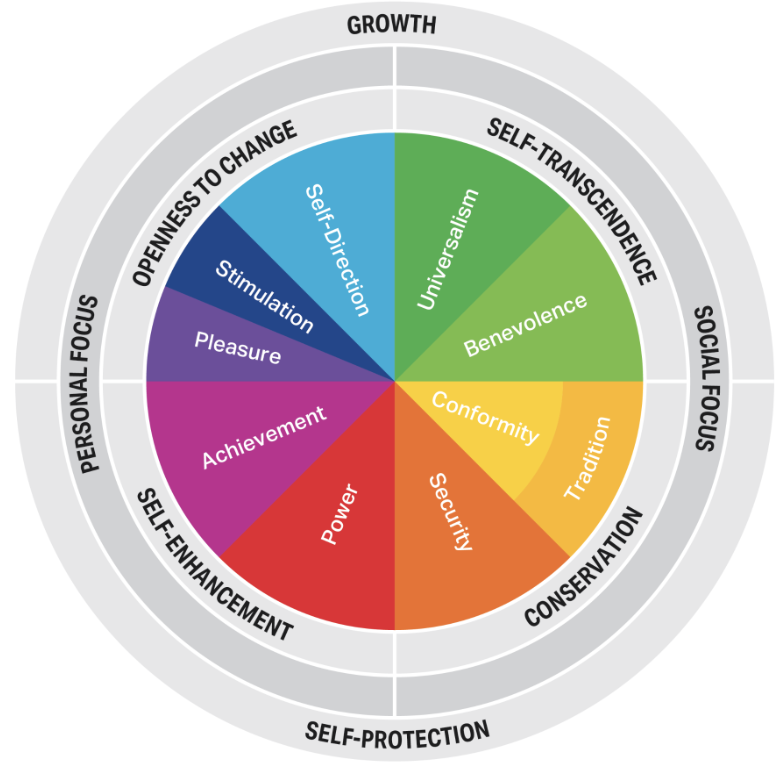
Value wheel from Schwartz’s Theory of Basic Human Values
Understanding your values helps you avoid making decisions that are inconsistent with your own ideals. This is important because it is the basis of my first decision making razor:
1) “Don’t do anything that would make you dislike yourself”.
I believe self esteem comes from acting in a way that you’d admire. Your reputation with yourself is the most important because you’re the only person you can’t get away from. If you’re constantly making decisions that you do not find admirable, or worse, disgust you, you will build a life of self resentment. To me, that is a personal hell.
The essence of the human condition is that we strive for ideals that we constantly fall short of. In Romans 7, Paul says "For the good that I would I do not: but the evil which I would not, that I do." Aristotle describes a similar concept of “akrasia” in which people know the right actions to take, but their reason is overtaken by their appetites and they act against what they know to be right. If the most prolific saints and philosophers could not act perfectly, I expect to fall short myself at times and reserve some grace.
We are human and we will fail, but understanding and defining your values will help you intentionally steer your decisions in ways that improve your relationship with yourself.
Goals are your desired states with various timeframes and levels of certainty. Meaningful goals start with the idea of “what do I want my life to look like in X time” and the actions are worked backwards from there. Be cautious of shallow goals in the form of “I want to have or receive X”. These can be meaningful motivators but build a shallow life.
Life is a strategy game. The clearer your goals are, the easier it is to make effective decisions. As the saying goes “if one does not know to which port he is sailing, no wind is favorable”. But, we live long lives where both our internal and external world evolves. Because of this, goals should be evaluated for their level of certainty and the rigidity of their prerequisites. For example, if you want to work as a doctor, there is a rigid set of steps to get there. If you are interested, but not certain of that goal, you can make decisions that account for the prerequisites as not to close that path off prematurely. You can get an undergraduate degree that gives you opportunities to do something else but also preserves your ability to pursue the medical path. If you are a woman that may want to have a family, biology forces you to prioritize that within a specific time frame. Your life strategy needs to account for the potential future goals that have a long runway. I took extra classes in high school to free up credit space in college. I used that space to get a minor in economics. I used that minor in economics to shorten the courseload I needed to get my MBA while working full time. Even if I never use my MBA, the forward thinking of potential future goals allowed me to efficiently set myself up for success in the event that I want to leverage it in the future. It was a life strategy decision.
I base the permanence and specificity of my decision around the certainty of my convictions and the stability of the surrounding environment. If I don’t have strong conviction or a stable sense of the future, I opt for an evergreen diversified approach. When I make investment decisions I’m not knowledgeable enough on specific companies to hold strong convictions, and the economic landscape for individual entities is shaky at best. Here I take the broadest, most diversified approach. I don’t care much for cars so I chose the most reliable, widely available model. When I am working within an area that I understand deeply and I am passionate about, I make specific narrow decisions that may not be the widely accepted approach. I am getting married because I am extremely confident in my choice in a partner and my desire to have a family. There is no foreseeable technological or social shift that would sway me from that goal. That is my second razor:
2) “Base the specificity of your decisions on your level of conviction and confidence in the future. Evergreen, diversified approaches can cover your certainty gaps.”
The final piece of that sentence is understanding that life is a probabilistic game. There are very few meaningful decisions that are made with complete certainty of the outcome. Life is analogous to a game of poker. You are playing based on the hand you are dealt and you make decisions based on incomplete information with the fickle hand of fate putting its finger on the scale. There are objectively correct decisions in poker that can still lose because a low probability card turned on the river. There are people that go all in with 3/7 unsuited but still win when another player informs them that they have a straight.
All decisions are essentially a hypothesis: If I choose this, I expect this is likely to happen as a result. This expectation is built on your model of the world. So, the quality of your world model impacts the quality of your decision making. Study history, physics, economics and human nature to get a clear picture of how the world works. It is pattern recognition. Constantly update your world model based on new information. Test your assumptions against reality. If your hypothesis repeatedly yields unexpected results, it's time to change the model. Most importantly, my third razor :
3) “Act based on the world as it is and not the world as you believe it should be.”
This is the biggest thing that I see leading to unsuccessful decisions from people that have otherwise clear values and goals.
Decisions are necessary. In my early 20s, I’d make almost all of my decisions to preserve optionality. I wanted to maximize my freedom and prevent locking myself into something. This is fine when you are young and “full of potential” - like a rocket full of fuel, ready to be aimed somewhere. But as we know from physics, potential energy does no work until it is converted into another form. At some point, still just having “lots of potential” means you’ve failed to launch. And potential, or the belief that you have potential, is a corrosive fuel that eats away at its tank if it is left unused for too long .
Homozi repeatedly explains that the root of the word "decision" is the Latin verb decidere which means “to cut off”. Metaphorically, a decision is cutting off every alternative path in order to commit to one. The hardest lesson that I’ve had to accept is “you can have anything you want, but not everything you want.” As a curious person that learns quickly, I can pick up new skills fairly easily. This is a blessing and a curse because it opens up many truly viable paths in life that I can’t simultaneously pursue. If you’re only good at one thing, choosing a path is simple. Wanting it all is a recipe for stagnation, entitlement and disappointment.
Something that has helped me cope with this is a loose belief in reincarnation. I say “while I am here, in this body, in this lifetime, I am choosing this path.” Maybe in my next life I will be the nomadic philosopher that opts for travel over a stable family. Maybe I’ll choose to pursue a different career field. Maybe I’ll be a manatee and won’t have to worry about taxes or . Regardless of the validity of the belief, it helps me commit to my current path without grieving the ones that I’ve closed. Every life has regrets because you can’t do it all, so proactively choose them instead of looking back negatively.
4) You’ll experience a better life if you actively choose and accept your regrets.
Sometimes you won’t know if you made the right decision, so make the decision then make it right.
Understanding this framework helps to both build empathy and preserve your autonomy. How many times have you thought “How could someone be so stupid to make that decision, I would never have done that”. Well, it's very likely that someone has different values than you, and probably different goals too. It's also likely that they have a different world model which predicts a different outcome from that action. Values are not inherently right or wrong, some people prefer social cohesion over individual growth or security over exploration. Applying your goals, values and world model to someone else's decisions will usually make them seem incorrect. This is why I seek perspectives and not advice. Most people address advice in the context of their values and world model, not yours. This is also why (in addition to my OCEAN assessment determining I am 7th percentile in agreeableness) I don’t base my decisions off of someone else's values or goals. If you know your values and goals, you’re less likely to be guilted into making a decision that serves someone else. Collect perspectives and weigh them based on how frequently that person's expected results tend to match their reality. This means they have a reliable worldview and may be able to fill the gaps in your own. This is razor 5:
5) “Collect input, but make your own decisions”.
A life is built one decision at a time. Inaction or deferring to others is still a decision. If your life is not designed by you, it will be assigned to you.
Start by discovering your values.
Then, set some life goals.
Next, make some choices that increase your likelihood of getting there.